News
TESOL Training – 3
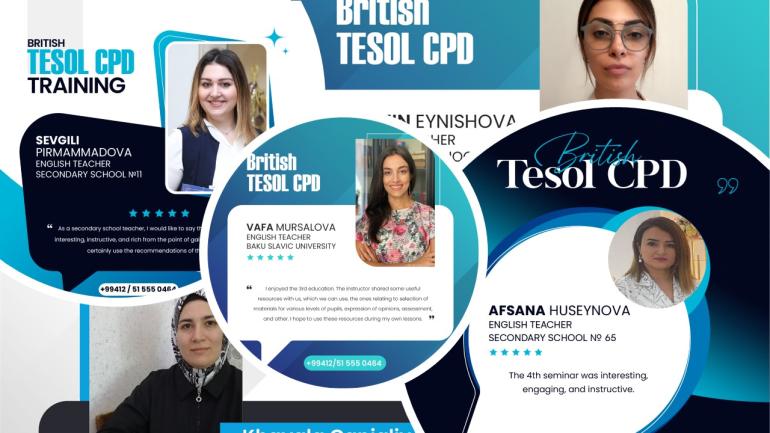
On August 31st, the BRITISH TESOL CERTIFICATE TRAINING, developed by the Imperial English Azerbaijan (IEAZ), was completed as part of the project on the application of new innovative methodologies, approaches, pedagogy, and assessments in teaching English aimed at further development of teachers' teaching skills in English language.
Total duration of the training course was 50 hours, which included theory and basic knowledge, new teaching skills and ideas, videos, Power Point presentations, research articles and teaching notes, practical training materials, exchange of valuable experience with teachers and online seminars. The first 40 hours of the training course consisted of independent work, and the remaining 10 hours were online seminars. The seminars were conducted by Mr. Rafael Salguero, Deputy Principal of Birmingham College, Head of the Department of Teaching at Imperial English UK, world-class instructors Matt Kendrick, Eli Ghazala, Stephanie Diamond Bair and Professor Inga Diakonidze from Kutaisi International University.
The first training seminar began with the introduction of Mr. Rafael Salguero and Matt Kendrick to the Azerbaijani teaching staff who joined the training. Then a discussion began on the topic related to the use of modern methods of the 21st century in teaching, where traditional and modern teaching methods were contrasted. It was emphasized that a lesson based on modern teaching methods, in contrast to the traditional method, is focused not on the teacher, but on the students. In the traditional method of teaching, where teachers have more responsibility for the class, teachers do not have the opportunity to inspire their students with their charisma and knowledge, which ultimately leads to "transfer of learning" to the classroom atmosphere, without diversity, whereas in teaching based on modern methods the main factor is the formation of motivation, bringing students to the forefront and the use of methods and techniques for interactive learning. It was also emphasized that checking for understanding of given instructions, using by the students of appropriate language levels and obtaining feedback from students at the end of the lesson are the basis of modern teaching.
/3ENG/1.jpg)
The second workshop led by Eli Ghazala was focused on discussion of the 4C's method, namely; which student should be assigned which task, the importance of strengthening and centralizing each student's attention, making all students involved, and collecting responses from all students within a few seconds. It was stated that all the above-said should cover only 10-15% from the total duration of a lesson. In addition, Mr. Eli Ghazala taught new words, their meaning, spelling, pronunciation, types, place in a sentence, etc., and also gave extensive information that it was wrong to ask second language learners to construct sentences only from the newly learned words. Eli Ghazala noted that there were more than 70 methods by which students could understand the meaning of unfamiliar words in a text, and emphasized the importance of learning of at least 18 of them.
/3ENG/2.jpg)
The third workshop was dedicated to the discussion of academic level topics, academic writing, essay, abstract, editing and editing tools, dissertation, essay, difference between dissertation and essay, plagiarism, etc. Information research and learning in large classrooms were also discussed, and the possibility of using specific methods based on the experience of instructors to develop students' academic English in school settings was considered.
/3ENG/3.jpg)
Focusing on developing writing and listening skills, the 4th workshop covered topics such as spelling, punctuation, grammar, rough notes, checking writing, making corrections, using authentic listening texts, listening strategies, technical preparation before listening and familiarization with some foreign languages.
/3ENG/4.jpg)
The last 5th training workshop was focused on words, word meanings, distortions in context, word order in a sentence, spelling, stress in words and sentences, phonemes, intonation, language skills, use by the students of key words, creating new words, developing reading skills by joining combinations of words to another word, creating new phraseological combinations using phrases, in general, everything that introduces innovations into the language. Overall, the classroom reading focused on language skills, as well as improving skills such as observation, writing skills, and asking thought-provoking questions.
/3ENG/5.jpg)
At the end, at the closing ceremony, all the teachers who took part in the training stated that it was useful for everyone, that they would benefit from the experience of the international instructors in their classes and that they would apply the new interactive teaching methods and techniques that they had learned in the process of teaching.
Comments
Send a Comment
Search
Recent News
2 weeks before by Gulnara Mammadova
2 weeks before by Emil Abdurahmanov
2 weeks before by Emil Abdurahmanov